Review ROI Calculator: See Exactly How Much Money Bad Reviews Are Costing Your Business
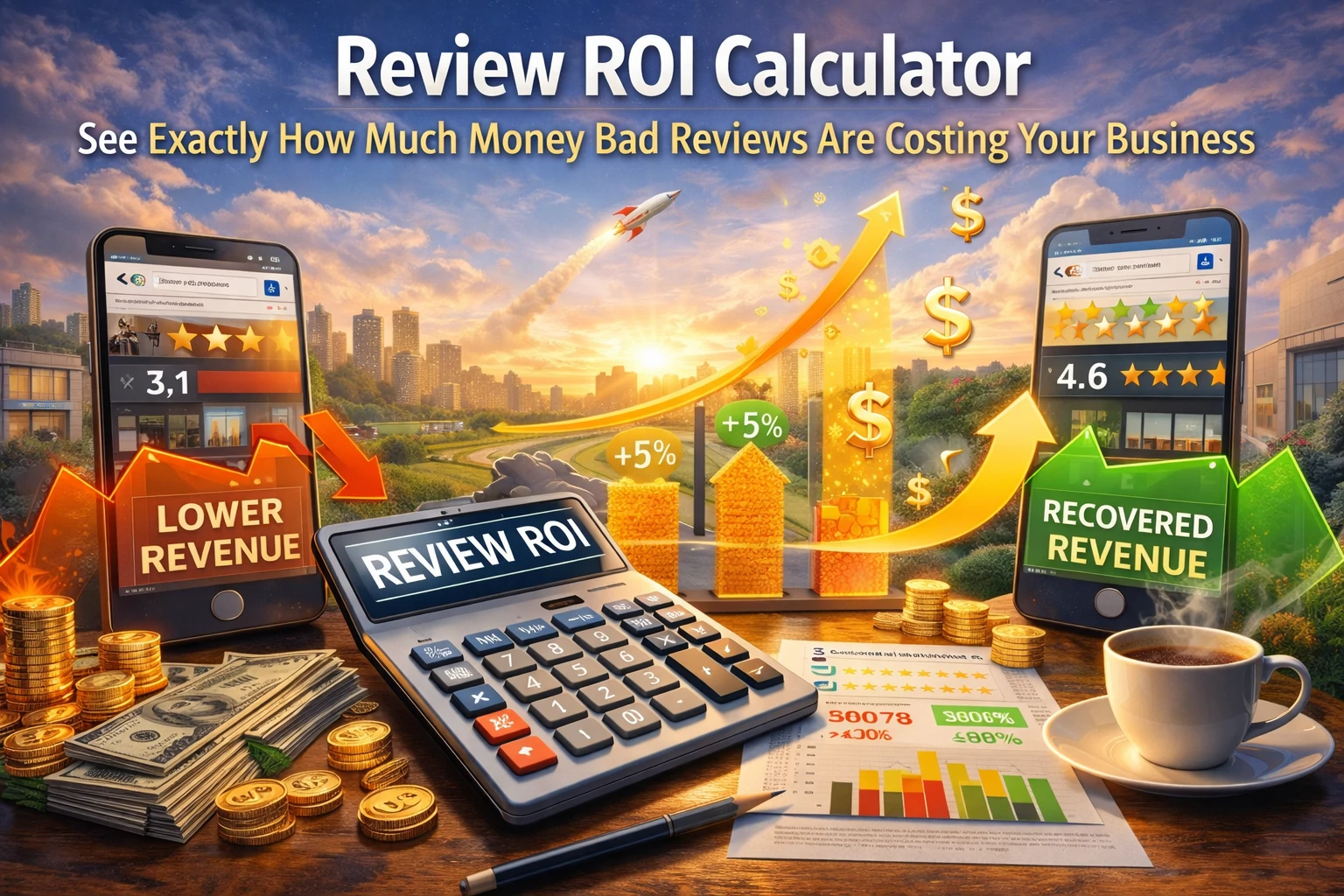
Bad reviews don't just hurt your pride. They hurt your conversion.
Because reviews don't sit on your profile like decoration. They decide whether someone clicks, calls, books, or bounces.
This article gives you a simple, numbers-first "Review ROI Calculator" you can use to estimate what low ratings, negative recency, and weak review response habits are costing you right now—and what it's worth to fix.
The "Review Revenue Leak" in one sentence
Bad reviews cost you money by reducing the percentage of people who choose you after they discover you. So the calculator is simple: if you can estimate discovery, conversion, and customer value, you can estimate the revenue leak.
A quick compliance note
If your marketing includes "swapping value" (freebies, perks, upgrades, discounts), be careful how you apply it on review platforms. Google prohibits offering incentives in exchange for posting reviews, revisions, or removing negative reviews. Yelp states businesses should not ask for or solicit reviews and may apply penalties for solicitation.
The safe lane: swap value for private feedback and customer appreciation, then keep public review requests policy-safe.
Choose your calculator
You have two ways to estimate review ROI. Use whichever is easiest with the data you have today.
Option A: The Conversion Calculator (works for any business)
Use this if you can estimate your monthly leads, your close rate, and the value of a customer.
Option B: The Star-Impact Shortcut (fast scenario planning)
Use this if you want a quick estimate based on rating improvement. A well-known Harvard study found that, for independent restaurants on Yelp, a one-star increase was associated with a 5–9% revenue increase.
Option A: The Conversion Calculator
Step 1: Fill in your inputs
- Monthly leads (calls + forms + DMs + bookings + walk-ins)
- Close rate (what % becomes paying customers)
- Average ticket (average first purchase)
- Gross margin (your profit %)
- Optional: 12-month value multiplier (repeat purchases, follow-up work)
Step 2: Calculate your baseline
- New Customers / Month = Leads × Close Rate
- New Revenue / Month = New Customers × Average Ticket
- Gross Profit / Month = New Revenue × Gross Margin
- Optional 12-Month Profit = Gross Profit × 12-Month Value Multiplier
Step 3: Apply "review drag" scenarios
Now estimate how much reviews are suppressing your conversion. If you don't have tracked data yet, run scenarios to bracket reality.
- Conservative lift: +5% conversion
- Moderate lift: +10% conversion
- Aggressive lift: +15% conversion
Recovered Profit / Month = Baseline Profit × Conversion Lift %
Option B: The Star-Impact Shortcut
Estimated Revenue Lift % = (Target Rating − Current Rating) × (Lift per star). Restaurant anchor: 5–9% per star for independent restaurants (Yelp context).
Recovered Revenue / Month = Monthly Revenue × Lift %. Recovered Profit / Month = Recovered Revenue × Gross Margin.
The "hidden multipliers" that make review ROI bigger than you think
1) Responding to reviews is a trust lever
BrightLocal's 2024 survey found consumers are 41% more likely to use a business that responds to all reviews than a business that doesn't respond to any.
2) Thresholds matter (especially around 3.0 and 4.0)
71% of consumers would not consider using a business with an average rating below three stars, and businesses should aim for a minimum average star rating of 4.0.
3) Review count and recency shape whether people trust the score
Most consumers expect a business to have 20–99 reviews to trust the average rating, and a meaningful share of consumers expect reviews to be as fresh as two weeks.
A worked example
Example business: Monthly revenue $80,000, gross margin 40%, current rating 3.7, target rating 4.3 (a +0.6 improvement).
Lift range = 0.6 × (5% to 9%) = 3% to 5.4% revenue lift. Recovered revenue = $80,000 × (3% to 5.4%) = $2,400 to $4,320 / month. Recovered profit = (Recovered revenue) × 40% = $960 to $1,728 / month. Annualized: $11,520 to $20,736 in gross profit recovered.
How to make the calculator "exact" in the real world
You don't get precision by guessing harder. You get it by tracking before-and-after.
Week 1: Capture your baseline
- Monthly leads by channel (calls, forms, DMs, bookings)
- Current close rate
- Average ticket and gross margin
- Current rating, review count, and review recency
- Response rate and response speed
Weeks 2–6: Improve the controllables
You don't need magic. You need consistency: better response habits, fewer repeated service failures, and a steady stream of recent customer feedback (done policy-safe).
Week 7+: Recalculate using your observed conversion change
Once your close rate or lead-to-customer conversion improves, your ROI stops being theoretical. It becomes a measurable delta.
Bottom line
If reviews are suppressing conversion by even a small percentage, the money adds up fast. Run the calculator, pick a conservative scenario, and you'll usually find the same thing: fixing your reviews isn't "marketing." It's plugging a revenue leak.